
No products added!
Vypracovaná maturitná otázka · Anglický jazyk
English-Speaking Countries
Celá téma presne tak, ako vyzerá v knihe — slovná zásoba na troch úrovniach, ustálené spojenia, idiómy, modelová odpoveď v A2, B1 aj B2, a úlohy na ústnu časť.
Jedna z 24 tém z knihy The Complete Maturita Companion
1 · Slovná zásoba — rebríček A2 → B1 → B2
Porovnaj slovnú zásobu a modelové odpovede. Označenia A2, B1 a B2 sú orientačné: výsledok skúšky závisí od celej odpovede, jej správnosti, plynulosti a splnenia zadania, nie od jednej frázy.
| POJEM | A2 | B1 | B2 |
|---|---|---|---|
| Spojené kráľovstvo a Veľká Británia | England, London | the United Kingdom (UK); Great Britain = England, Scotland and Wales | the UK = England, Scotland, Wales & Northern Ireland |
| USA | America, New York | the United States / fifty states | a federal republic / the East and West Coast |
| ďalšie krajiny | — | Ireland, Canada, Australia | New Zealand / the English-speaking world |
| jazyk | English | British vs American English | accents / dialects / a lingua franca |
| rozdiely | different words | lift/elevator, football/soccer | spelling and vocabulary differences |
| pamiatky | Big Ben | Tower Bridge, the Statue of Liberty | iconic sights / world-famous landmarks |
| kultúra | the Queen / the King | the royal family / traditions | multicultural societies / cultural exports |
| prečo angličtina | English is important | a world language | the language of science, business and the internet |
Čo komisia naozaj testuje
Great Britain je ostrov (tri národy). The UK navyše zahŕňa Severné Írsko.
Hlavné mesto USA je Washington, D.C. — nie New York.
Big Ben je v skutočnosti zvon, nie veža. Jedna veta skutočného detailu je viac než päť názvov.
Lingua franca — spoločný jazyk sveta. Fráza, ktorá okamžite zdvihne úroveň odpovede.
2 · Ustálené spojenia, úroveň po úrovni
A2ZÁKLAD
- The capital of … is … — The capital of the UK is London; the capital of the USA is Washington, D.C.
- People speak English in… — People speak English in Britain, America, Australia and many other countries.
- a famous sight — Tower Bridge is one of the most famous sights in London.
- I would like to visit… — I would like to visit Scotland and see the lakes.
B1ZÁKLADNÁ ÚROVEŇ
- to consist of — The UK consists of four countries — England, Scotland, Wales and Northern Ireland.
- an official language — English is an official language in more than fifty countries.
- to improve your English — A summer in Ireland improved my English more than three years of lessons.
- cultural differences — Queueing is not a habit in Britain — it’s a value.
B2VYŠŠIA ÚROVEŇ
- a global lingua franca — English is the global lingua franca of science, aviation and the internet.
- a melting pot of cultures — London and New York are melting pots — hundreds of languages in one city.
- to immerse yourself in the language — The fastest way to fluency is to immerse yourself in the language.
- mutual intelligibility — British and American English have almost complete mutual intelligibility.
3 · Šesť idiómov, ktoré sa oplatí vedieť
- when in Rome, do as the Romans do — rešpektovať miestne zvyky
- it’s all Greek to me — vôbec tomu nerozumiem
- to talk the same language — rozumieť si
- a home from home — miesto ako doma
- to broaden your horizons — rozšíriť si obzory
- across the pond — na druhej strane Atlantiku
4 · Modelová odpoveď — jedna otázka, tri úrovne
Otázka komisie: „What do you know about English-speaking countries, and why are you learning English?“
A2ZÁKLAD
English is spoken in many countries — in Britain, the USA, Canada, Australia and Ireland. The capital of Britain is London and the capital of the USA is Washington. I would like to visit London and see Tower Bridge and Big Ben. I learn English because it is a world language. With English I can travel, watch films and find a good job.
B1B1 — modelová odpoveď na precvičovanie
Quite a lot, I hope! The UK consists of four countries — England, Scotland, Wales and Northern Ireland — with London as the capital. The USA has fifty states, and its capital is Washington, D.C., not New York, which surprises people. English is also the main language of Canada, Australia, New Zealand and Ireland, and an official language in dozens of other countries. I’m learning it for practical reasons: it’s the language of the internet, travel and most good jobs — but also because I genuinely enjoy understanding songs and films without subtitles.
B2VYŠŠIA ÚROVEŇ — úroveň, ktorú si zapamätajú
Let me start with the map, then the reasons. The UK — four nations, one state, and a national sport of being misunderstood: Great Britain is the island, the UK includes Northern Ireland, and Big Ben is technically the bell. Across the pond, the USA — fifty states, capital Washington, D.C. — exports its culture so successfully that I knew American high schools from films before I knew my own timetable. Add Ireland, Canada, Australia, New Zealand and dozens of countries where English opens doors, and you get the real point: English stopped being a national language and became the world’s operating system — the lingua franca of science, business, aviation and, crucially, memes. Why am I learning it? Ambition, honestly: it multiplies every other skill I have. But somewhere along the way it stopped being an investment and became a pleasure — the day you first laugh at a joke in another language, the language quietly becomes yours.
5 · Ústna časť — úlohy na precvičenie
Opis obrázka. Opíš dve fotografie: londýnsku ulicu s poschodovým autobusom a newyorskú ulicu so žltými taxíkmi. Porovnaj obe mestá a povedz, ktoré by si radšej navštívil.
Role-play. Hostíš študenta z Británie. Opýtaj sa ho na život v UK — škola, jedlo, voľný čas — odpovedz na jeho otázky o Slovensku a nájdite tri veci, ktoré majú vaše krajiny spoločné.
6 · Cvičenia
Každá téma v knihe končí piatimi typmi cvičení. Toto sú tie k tejto téme — presne tak, ako sú v knihe.
A — Gap-fill
Complete each sentence with the missing phrase from this unit.
- ____________________ Britain, America, Australia and many other countries. (A2)
- I ____________________ Scotland and see the lakes. (A2)
- English is ____________________ in more than fifty countries. (B1)
- A summer in Ireland improved my ____________________ more than three years of lessons. (B1)
- English is the ____________________ of science, aviation and the internet. (B2)
- The fastest way to fluency is to immerse ____________________. (B2)
- Despite the jokes, British and American English have almost complete ____________________. (B2)
B — Idiom Match
Match each idiom (1–6) with its meaning (a–f).
| IDIOM | MEANING | ||
|---|---|---|---|
| 1 | when in Rome, do as the Romans do | a | a place as comfortable as home |
| 2 | it’s all Greek to me | b | to understand each other |
| 3 | to talk the same language | c | I don’t understand it at all |
| 4 | a home from home | d | to widen your experience |
| 5 | to broaden your horizons | e | on the other side of the Atlantic |
| 6 | across the pond | f | follow local customs |
C — Collocation Completion
Complete each sentence with a word from the box.
accent · royal · exchange · working · widely · anthem · native · double-decker
- You don’t need to sound like a ____________ speaker — you need to be understood.
- The taxi driver had a strong ____________ and stronger opinions.
- The ____________ family is Britain’s longest-running TV series.
- Ride a ____________ bus once — top deck, front seat.
- The crowd sang the national ____________ before kick-off.
- The ____________ programme places students with host families.
- A ____________ holiday in Australia is my cousin’s master plan.
- English is the most ____________ spoken second language in history.
D — The Ladder Challenge
You are given the A2 word. Write the B1 and B2 versions from this unit’s ladder.
- England, London → B1: ____________________ B2: ____________________
- America, New York → B1: ____________________ B2: ____________________
- English → B1: ____________________ B2: ____________________
- different words → B1: ____________________ B2: ____________________
- the Queen / the King → B1: ____________________ B2: ____________________
- English is important → B1: ____________________ B2: ____________________
E — Maturita Speaking Practice
Typical oral exam questions on this theme. Answer out loud, in full sentences — then push one level higher.
- Which English-speaking country attracts you most, and what would you do there first?
- British or American English — which do you use, and does the choice matter?
- What has learning English given you so far, beyond marks?
- Is the global dominance of English fair to other languages?
- What do you know about the UK or USA that most tourists get wrong?
- Will English still be the world language in fifty years? What could replace it?
Ku každej téme patrí gramatika
G11 · Articles, Quantifiers & Countability
Slovenčina členy nemá — angličtina ich skrýva v každej vete. Kniha má 14 takýchto gramatických celkov a tabuľku Pair Them Up, ktorá každú tému spája s gramatikou, ktorú na ňu potrebuješ.
Charlie says
A dog entered the garden. Notice: first mention, any dog — ‘a’. Second mention, that specific intruder — ‘the’. I understood articles instinctively, because territory is always specific. Slovak gave you no articles; English gives you three (a, the, and silence). Learn when to say nothing — it is harder than it sounds.
1 · What you can say — the ladder
| FUNKCIA | A2 | B1 | B2 |
|---|---|---|---|
| first vs known | I saw a dog. The dog was small. | We found a café near the station. | It’s the kind of place you find once and never again. |
| general statements | I like dogs. | Life is expensive. Music helps me relax. | Happiness rarely announces itself. (zero article, B2 abstractions) |
| quantities | I have some money. I don’t have much time. | There were a few problems and a little confusion. | Hardly any of my friends read the news. |
| uncountables | — | Can you give me some advice? | The amount of information we face daily is absurd — most of it is noise. |
2 · The forms
a/an → singular countable, first mention or “one of many”: a teacher, an hour (sound, not letter!)
the → we both know which one: second mention, unique things (the sun), superlatives (the best), instruments (play the piano), seas/rivers/mountain ranges (the Danube, the Alps)
zero → plurals & uncountables in general (Dogs bark. Water is life.), meals, languages, school/home/work/bed as institutions, most countries & towns (Slovakia, in Nitra)
BUT: the USA, the UK, the Netherlands, the Czech Republic (plural or “republic/kingdom” names)
Countable vs uncountable — the Slovak danger list
Vždy nepočítateľné (singular verb, no “a”, no plural):
information · advice · news (news IS!) · money · furniture · luggage · homework · bread · hair · weather · knowledge · progress · traffic
Ako ich počítať: a piece of advice/information/furniture · a slice of bread · a sum of money
Quantifier grid
- countable: many · (a) few · several · a large number of
- uncountable: much · (a) little · a great deal of
- both: some · any · a lot of / lots of · plenty of · no · hardly any
- a few / a little = some, enough (positive) — few / little = almost none (negative feel)
3 · The rules
- a/an by SOUND: a university, a European (j-sound); an hour, an honest answer (silent h). a uniform, an umbrella — same letter, different sounds, different articles.
- the = both speaker and listener know which one. That is the entire secret of “the”. Close the door. I met a girl… the girl turned out to be my cousin.
- General plural and uncountable ideas take no article — the Slovak instinct to add nothing is finally correct here. Teachers deserve respect. Coffee keeps students alive.
- Fixed institution phrases: at school, at home, at work, in bed, in hospital, to church — no article when used for their purpose. She’s at school (studying). Her mum is at the school (the building).
- some in positives and offers/requests; any in negatives and questions.
- much/many mostly live in questions and negatives; a lot of rules the positives.
- a few / a little = “some, luckily”; few / little = “almost none, sadly”. One letter of difference, opposite mood.
4 · Slovak Speaker Alert
Chyby, ktoré ti našepká materinský jazyk — a prečo každá z nich vzniká.
| ✗ NEHOVOR | ✓ POVEDZ | PREČO SA TO DEJE |
|---|---|---|
| She gave me many useful informations. | She gave me a lot of useful information. / …several pieces of useful information. | „Informácie“ je v slovenčine množné číslo — information nikdy. Tá istá pasca platí pre advice, news a furniture. |
| I am student of grammar school. | I am a student at a grammar school. | Povolania a roly potrebujú a/an. Úplne prvá veta na skúške — tú maj nepriestrelnú. |
| The life is hard. | Life is hard. | Abstraktné všeobecnosti majú nulový člen. „The life“ znamená jeden konkrétny život — a potom musíš povedať čí. |
| My brother is in the hospital. | My brother is in hospital. | Inštitúcie strácajú člen, keď sa používajú na svoj účel (britská angličtina; v americkej angličtine je „in the hospital“ bežné aj pri pacientovi). |
| I don’t have much friends here. | I don’t have many friends here. | Friends sú počítateľné — much slúži len nepočítateľným. |
| The news are good. | The news is good. | News vyzerá množne, správa sa jednotne. Jeden z malých žartov angličtiny na účet Slovanov. |
5 · Maturita Corner
Kde sa to objaví na skúške
Articles are invisible until they are missing — and in the written parts, missing articles are the fastest way to signal a lower level. Quantifiers appear directly in language-in-use tasks (much/many, few/little) and in every opinion answer (“Many people think…, but hardly any of them…”).
Taktický tip
Before handing in any written task, do one dedicated “article pass”: read only for nouns, and ask each singular countable noun a single question — a, the, or a very good reason for nothing? Two minutes, disproportionate reward.
6 · Cvičenia ku gramatike
A — Complete with a, an, the, or — (zero article).
- My mother is ________ nurse in ________ hospital near our flat.
- ________ life without ________ music would be ________ mistake.
- We spent ________ hour by ________ Danube.
- ________ children learn ________ languages faster than ________ adults.
- She’s ________ most hard-working student in ________ class.
- I go to ________ school by ________ bus.
- They’re from ________ Netherlands, but they live in ________ Slovakia.
- What ________ awful weather! Let’s stay in ________ bed.
B — Each sentence contains one mistake. Find it and correct it.
- Can you give me an advice about universities?
- I have too much homeworks this week.
- She has played piano since she was six.
- There were only few people at the meeting, which was enough for us.
- The money are on the table.
- We visited the Bratislava last weekend.
C — Choose the correct option and be ready to explain why.
- How much / many luggage are you taking?
- There’s little / a little milk left — enough for one coffee.
- Hardly any / no of my classmates smoke.
- Have you got some / any brothers or sisters?
- Would you like some / any more soup?
- A number of students has / have complained.
D — Speak the Grammar
Out loud, in full sentences — the grammar only becomes yours when it leaves your mouth.
- Describe your family in six sentences, then re-check every noun: a, the, or nothing — and why.
- How much free time do you have, and how many hobbies fit into it?
- Give a foreigner three pieces of advice about visiting Slovakia. (Not “three advices”!)
- Talk about news for one minute — and keep “news” singular the whole time.
Toto je 1 z 24 tém
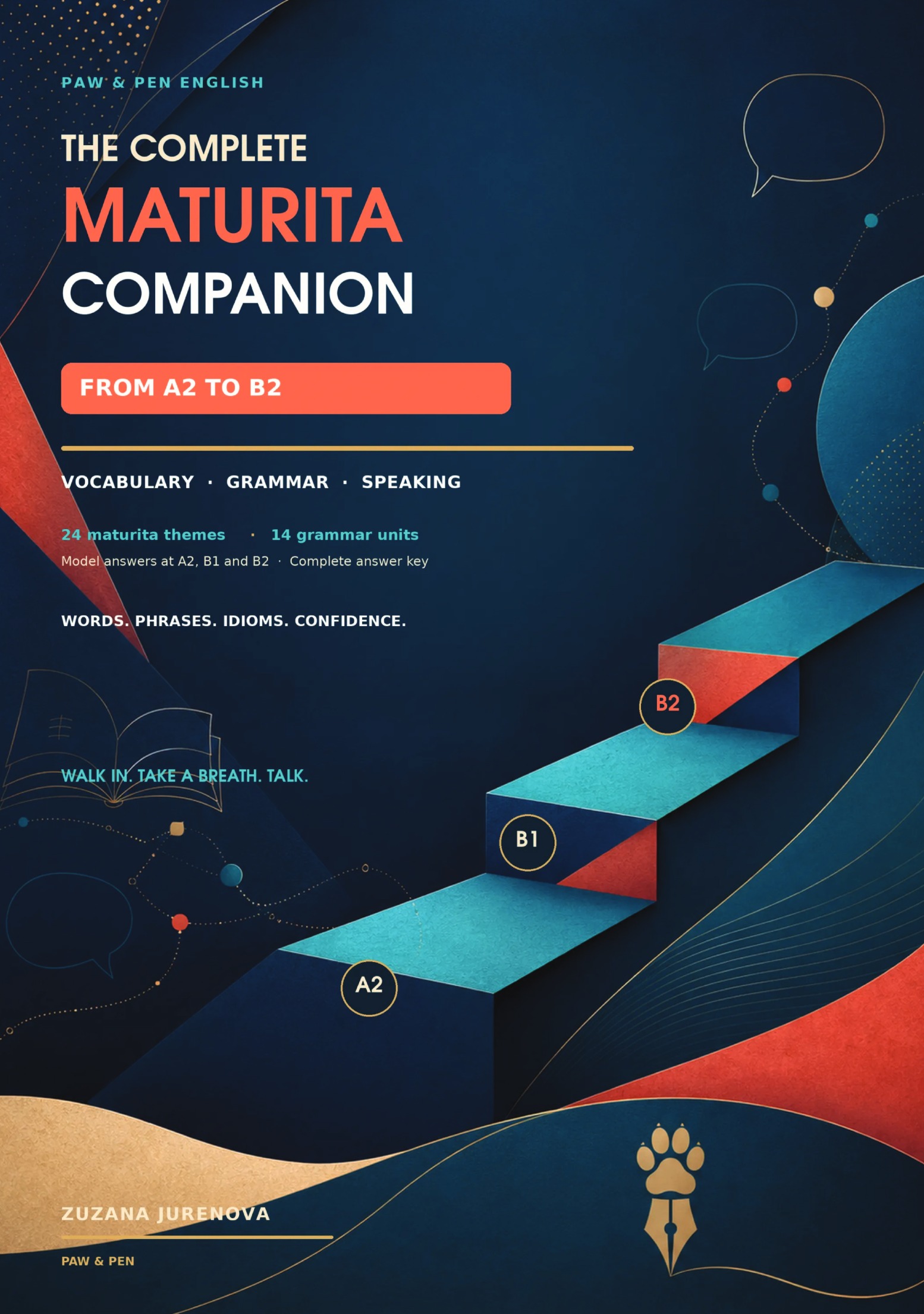
The Complete Maturita Companion
219 strán · 24 maturitných tém · 14 gramatických celkov · modelové odpovede v troch úrovniach · kompletný kľúč.
Píše Zuzana Jureňová, lektorka, autorka. Maturantov pripravujem súkromne, online aj osobne.